The hidden cost of ageing plant: when repair becomes a false economy
Aiden Wootton on why repairing ageing plant isn't always the cheaper option, and the hidden costs businesses miss when it becomes a false economy.
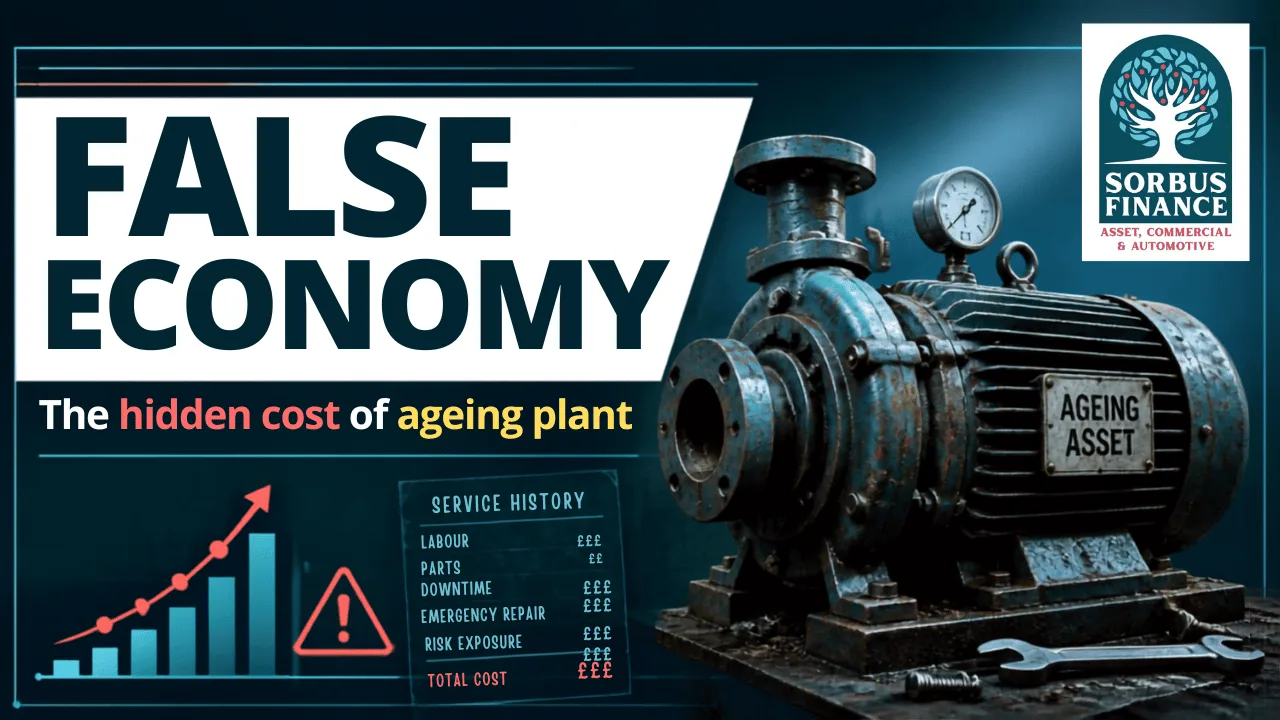
The hidden cost of ageing plant: when repair becomes a false economy
I get the instinct. I really do. You've got a machine that's given you eight, ten, maybe fifteen years of solid work, it's paid for itself several times over, and when something goes wrong the first thought is always the same. Just fix it. It's cheaper than buying new. Nine times out of ten that thought is correct. It's the tenth time that costs businesses far more than they realise, because that's usually the point where ageing plant stops being a reliable asset and starts being a slow, quiet drain on the business that owns it.
I spend most of my working life around engineering and manufacturing businesses, looking at exactly this decision about ageing plant, and the pattern repeats itself more than people expect.
Why the maths looks simple and isn't
On paper, repairing ageing plant almost always looks like the cheaper option, because you're comparing one number you can see against one number you can't. The repair quote is right in front of you. The cost of replacement is a bigger number and it's uncomfortable, so it gets pushed down the list. What doesn't get compared, because it's harder to put a figure on, is everything that repair doesn't fix. Ageing plant that's been patched back together tends to keep failing, just in different places each time. You fix the hydraulic seal this quarter and the control board goes next quarter on the same piece of ageing plant. Each repair on its own looks like a reasonable, defensible decision. Add them up over eighteen months and you've often spent more than a replacement would have cost, and you've still got a machine that's one more failure away from another invoice.
That's the false economy hiding in plain sight. It isn't one bad decision, it's a series of individually sensible ones that quietly compound.
The costs nobody puts on the repair invoice
The repair bill only ever tells you part of the story. Ageing plant carries costs that never show up on that piece of paper but absolutely show up on the bottom line.
Downtime is the obvious one. Older equipment tends to fail without much warning, and when it does, production stops. If that machine sits in the middle of a production line rather than off to one side, the cost of that stoppage can dwarf the repair bill itself within a few hours. I've seen businesses lose more in missed output during a two-day breakdown of ageing plant than the eventual repair cost them, and that's before anyone factors in the knock-on effect of late deliveries and strained client relationships.
Efficiency is the quieter cost. Ageing plant rarely fails all at once, it degrades gradually, and gradual decline is easy to normalise because you get used to it. A machine running at eighty percent of its original output doesn't announce itself the way a breakdown does. Nobody puts "reduced output" on a repair invoice, but it's there in the energy consumption, the cycle times, and the scrap rate, quietly costing money every single day the machine runs.
Parts availability is the one that catches businesses out hardest. As plant ages, particularly anything approaching fifteen or twenty years old, manufacturers start discontinuing components. What used to be a two day turnaround for a part becomes a six week wait for a reconditioned or reverse-engineered replacement, if one can be sourced at all. That's not a repair cost, that's weeks of lost production dressed up as a repair delay, and it's one of the most common reasons ageing plant ends up costing far more than anyone budgeted for.
And then there's safety and compliance, which nobody wants to think about until they have to. Ageing plant that's been repaired repeatedly can drift a long way from its original specification, and that matters when it comes to insurance, inspection, and basic workplace safety. A machine that technically runs isn't the same as a machine that runs the way it was designed to.
How to tell when you've crossed the line
There isn't a single moment where ageing plant tips from asset to liability, but there are patterns worth watching for, and once you know what to look for they're not hard to spot.
The first is frequency. If the same machine has needed three or more unplanned repairs in twelve months, that's rarely bad luck, that's a machine telling you something about where it is in its lifecycle. The second is cost trajectory. If each repair is costing more than the last, even for unrelated faults, that's usually a sign the whole machine is wearing out rather than one component failing in isolation. The third is opportunity cost. If newer equivalent equipment would meaningfully improve output, reduce energy use, or cut labour requirements, the comparison isn't really repair versus replace anymore, it's the cost of standing still versus the cost of moving forward, and ageing plant tends to lose that comparison quietly over time.
The fourth, and the one people find hardest to act on, is confidence. If you or your team have stopped trusting a machine to get through a shift without incident, that lack of confidence has a cost too, even if it never appears on an invoice. Businesses start building slack into schedules around unreliable ageing plant, holding buffer stock they wouldn't otherwise need, or quietly routing work away from a piece of ageing plant everyone's stopped trusting. That's a real cost, it's just one that's easy to overlook because it never arrives as a single bill.
Repair still makes sense more often than not
I want to be clear about something, because it's easy for a piece like this to sound like it's arguing against repair altogether, and that's not the point I'm making. Repair is still the right call most of the time. Ageing plant that fails once, gets fixed properly, and goes back to reliable service for another few years is exactly how equipment should be managed. The problem isn't repair itself, it's treating every repair decision as if it exists in isolation, without stepping back periodically to look at the pattern the ageing plant is actually showing you.
The businesses that manage this well tend to do one simple thing differently. They track it. Not in a complicated way, just a basic record of what's failed, when, and what it cost, kept against each significant piece of ageing plant. That record does something a single repair quote never can, it shows you the trend rather than the moment, and trend is what actually tells you whether a piece of ageing plant is having a bad year or reaching the end of its useful working life.
Why this is worth thinking about now rather than during a breakdown
The worst time to make a decision about ageing plant is in the middle of an emergency, with production stopped and pressure building to get a fix agreed as fast as possible. Under that kind of pressure, repair almost always wins by default, because it's the option that gets a machine running again today. That's completely understandable, and it's also exactly how businesses end up several repairs deep into a machine that should have been replaced eighteen months earlier.
The businesses I see managing ageing plant well are the ones having this conversation before the breakdown, not during it. They know roughly where each significant piece of equipment sits in its lifecycle, they've got a rough sense of what a replacement would look like and cost, and when a failure does happen, they're making a considered decision rather than a panicked one. That difference alone changes the outcome more often than people expect.
Ageing plant isn't something to be anxious about, it's something to be honest about. Most equipment earns every extra year of service it gets through good maintenance and sensible repair. The trick is noticing, calmly and in good time, when a particular machine has quietly moved from being an asset worth keeping to a cost worth questioning.
Aiden Wootton works with engineering, manufacturing, and trades businesses across the Sorbus Build client base, and spends a good portion of his time in workshops and on factory floors talking through exactly this kind of decision with the people who actually run the machines.
A few questions I get asked about ageing plant
How do I know if my equipment counts as ageing plant? There's no fixed age, it depends on the equipment type, usage intensity, and how well it's been maintained. The more useful question isn't age, it's whether repair frequency and cost on that ageing plant have started trending upward.
Is it always cheaper to repair than replace ageing plant? Not always, and that's the whole point of looking at ageing plant properly. A single repair is usually cheaper than replacement, but a pattern of repeated repairs on the same ageing plant often isn't, once downtime and lost output are counted honestly.
What's the first sign that ageing plant needs a proper review rather than another repair? Repeated unplanned failures on the same piece of ageing plant within a short period is usually the clearest signal. One breakdown is bad luck. Three within a year on the same ageing plant is a pattern worth taking seriously.
Ready to act on what you've read?
Get a free, no-obligation quote from 100+ UK lenders
Ready to find the right finance for your business?
Our independent advisers compare 100+ UK lenders to find the deal that fits your business, no upfront fees, no obligation.