Driving School Business Finance: Surviving the Test Backlog
DVSA's own data shows waits of up to 6 months at some centres. Here's how the backlog is hitting driving school income, and where driving school business finance fits in.
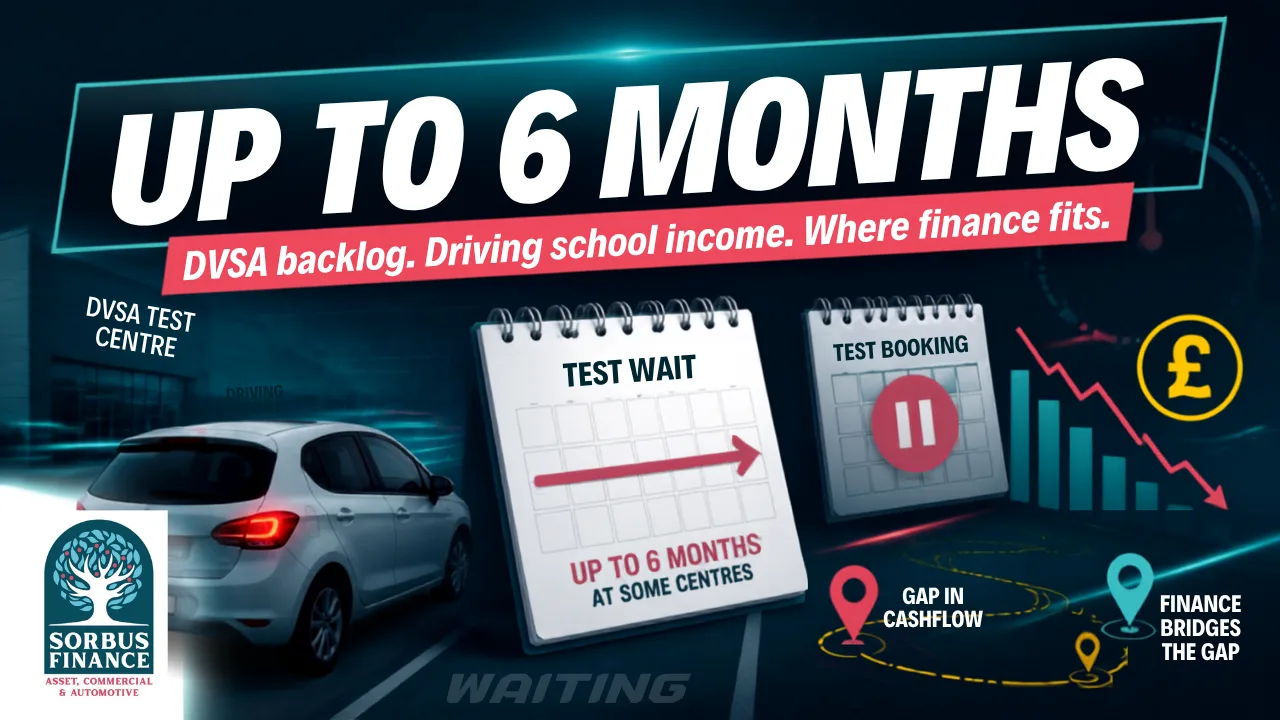
Inside the UK's Driving Test Backlog: 6 Months, and Counting
In short: DVSA's own July 2026 data puts the national average wait for a practical driving test at 11.1 weeks, with some individual test centres running at 24 weeks or more, close to 6 months. The Government's target of a 7-week average wait has been pushed back to autumn 2027. For driving schools, the backlog isn't just a pupil frustration, it's an income volatility problem, and it's changing how schools think about driving school business finance.
Ask any driving instructor what the single biggest challenge in their business is right now, and the answer is rarely about teaching. It's about waiting.
How Long Are Learners Actually Waiting?
According to DVSA's own published data for July 2026, the national average waiting time between booking and taking a practical driving test sits at 11.1 weeks. That average hides real variation: some individual test centres are running at 24 weeks or more, close to 6 months, while others are considerably shorter. Regionally, Scotland has the longest average wait at 15.6 weeks, more than double Wales's 7.6 weeks, with England matching the Great Britain average of 11.1 weeks.
This isn't a new problem, but it is a persistently unresolved one. The Government originally aimed to bring the average wait down to 7 weeks by the end of 2025. Transport Secretary Heidi Alexander has since confirmed that target won't be hit until autumn 2027, nearly two years later than first promised.
What's Being Done About the Driving Test Backlog UK
DVSA has made genuine progress, even if it hasn't closed the gap yet. The agency has delivered close to a quarter of a million extra car driving tests between June 2025 and May 2026 compared with the same period the year before, alongside a recruitment drive aiming to add 450 new driving examiners and reinstated overtime pay to free up additional evening and weekend slots.
Booking rules have also tightened to protect genuine learners from the bot and reseller activity that had been soaking up appointments. Since 8 April 2025, only the learner themselves, rather than instructors or third parties, can book and manage their own practical test, and cancelling or changing a booking now requires 10 full working days' notice to avoid losing the fee, intended to free up slots earlier rather than losing them to last-minute changes.
These measures are working in the sense that capacity is genuinely increasing. They haven't yet been enough to outpace demand, which is why the driving test backlog UK remains a live issue rather than a solved one heading into the second half of 2026.
How the Backlog Is Reshaping Driving School Businesses
DVSA's own October 2025 survey of approved driving instructors captures the practical effect of this backlog better than any external commentary could. When instructors were asked what's affected their business in the last few months, requests from pupils they haven't trained asking to be taken to a test came up in 83.4% of responses, and pupils taking extended breaks of three or more weeks was cited by 60.7%, both up from previous years. Among instructors whose pupils took extended breaks, 94.1% cited high driving test waiting times as the reason, by far the dominant factor above financial constraints or personal circumstances.
The knock-on effect shows up in the availability data too. 45.4% of instructors currently have availability to take on new pupils, up 8.8 percentage points from September 2024, while the proportion running a waiting list has fallen from 56.4% to 47.3% over the same period. On the surface, more availability sounds like good news. In practice, it reflects a system where pupils are pausing lessons mid-course to wait for a test date, freeing up instructor time that would otherwise be filled, rather than genuine growth in instructor capacity relative to demand.
When DVSA analysed the open comments instructors left about their key challenges, driving test availability and waiting times came up in 90% of them, by far the most common theme, ahead of DVSA policy issues, booking system exploitation, and pupil scheduling difficulties combined.
The Income Volatility Problem
For a driving school, this creates a specific and difficult pattern. Pupils don't stop wanting lessons, they pause them, sometimes for months, while they wait for a test date, then return wanting an intensive run of lessons to get test-ready again once a date finally lands. That stop-start cycle makes revenue considerably harder to forecast than a steady, predictable stream of weekly bookings.
ADI cash flow management has always mattered for a self-employed profession with no sick pay or guaranteed income, but the backlog has made it considerably harder to plan around. An instructor or school might have a fully booked diary one month and a string of paused pupils the next, through no change in their own teaching quality or local reputation, purely as a function of when test dates happen to land.
Vehicle costs don't pause when pupil bookings do. Fuel, insurance, and finance payments continue whether a school's diary is full or half-empty that month, which is exactly the kind of fixed-cost pressure that becomes harder to absorb when income is volatile rather than steady.
This is a different problem to the general cost pressures other sectors face. It's not that costs are rising, though they are, it's that income has become considerably less predictable around those costs. Good ADI cash flow management used to mean budgeting around a fairly steady weekly lesson income. Increasingly, it means planning for months where a school's most reliable pupils simply aren't booking lessons, not because they've lost interest or gone elsewhere, but because they're sitting in a queue waiting for a test date that's entirely outside anyone's control. A school with several instructors can see this compound further, since a cluster of pupils all pausing around the same regional test centre's backlog can hit monthly income far harder than a handful of individual pauses spread evenly through the year.
Driving School Business Finance: Managing Through the Uncertainty
This is where driving school business finance structured around flexibility, rather than a one-size-fits-all approach, earns its place in the conversation. Driving school vehicle leasing arrangements that allow schools to adjust fleet size gradually, rather than being locked into a fixed number of vehicles regardless of pupil volume, can help absorb some of the unpredictability the backlog has introduced.
For a growing school, driving school vehicle leasing also removes some of the risk around scaling up too early. Adding a car and an instructor to meet demand feels like the obvious move when a diary is consistently full, but committing to a large upfront purchase on the assumption that current demand will hold steady is exactly the kind of decision the backlog makes riskier than it used to be. A leasing structure that can flex with actual pupil volume, rather than locking a school into vehicle costs sized for a best-case month, matches the reality of a market where income now moves in waves rather than a steady line.
For schools managing several instructors and vehicles, flexible driving instructor finance structured around actual usage patterns, rather than treating every vehicle identically, gives more room to manage the income swings the backlog has made increasingly normal. Hire purchase remains sensible for a school with stable, long-term vehicle needs, while finance lease or contract hire options can offer more room to adjust as pupil volumes fluctuate around test availability rather than around anything the school itself controls.
None of this makes the backlog disappear, and no financing structure can substitute for DVSA actually closing the gap between test supply and demand. But treating driving school business finance as something to actively manage through this period, rather than a fixed cost set once and left alone, gives schools more room to absorb a problem that, on the Government's own timeline, isn't going away for at least another year. For a business built around teaching people to pass a test that increasingly takes months to book, that kind of financial flexibility isn't a luxury, it's becoming part of the job.
FAQ
How long is the current UK driving test waiting time? DVSA's July 2026 data shows a national average wait of 11.1 weeks between booking and taking a practical test, with some individual test centres running at 24 weeks or more, around 6 months.
When will UK driving test waiting times return to normal? The Government's target of a 7-week average wait, originally due by the end of 2025, has been pushed back to autumn 2027, according to Transport Secretary Heidi Alexander.
How is the driving test backlog affecting driving school income? DVSA's October 2025 instructor survey found 94.1% of pupils taking extended breaks from lessons cited high driving test waiting times as the reason, which creates unpredictable gaps in instructor and school income even as overall demand for lessons remains strong.
Why do driving schools need flexible vehicle finance during the backlog? With pupil numbers and lesson frequency fluctuating unpredictably around test availability, fixed high vehicle costs can strain cash flow during quieter periods. Flexible driving instructor finance structures help schools manage fleet costs through those swings rather than committing to inflexible terms.
Ready to act on what you've read?
Get a free, no-obligation quote from 100+ UK lenders
Ready to find the right finance for your business?
Our independent advisers compare 100+ UK lenders to find the deal that fits your business, no upfront fees, no obligation.