Asset finance vs bank loan: which is right for your business?
When you need to fund equipment or vehicles, should you use asset finance or a business loan? We compare rates, flexibility, tax treatment, and approval speed to help you choose.
Written by Sorbus Finance
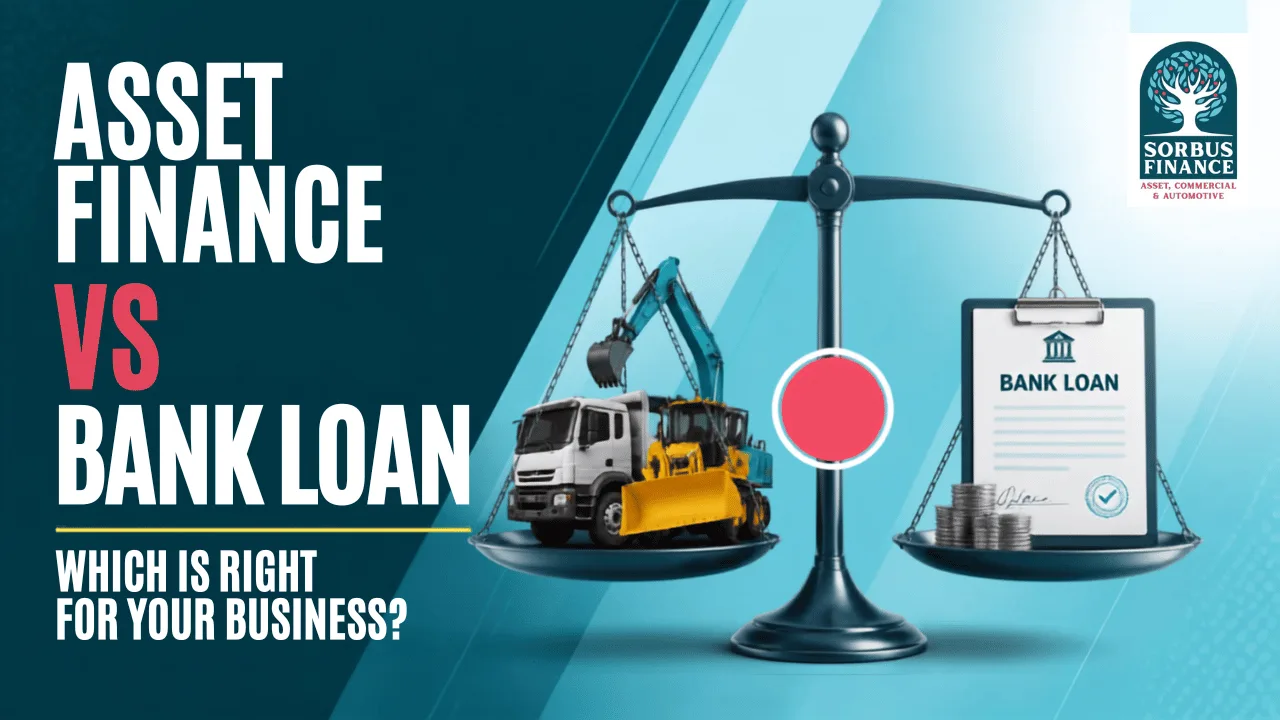
Asset Finance vs Bank Loan: Which Is Right for Your Business?
Every growing business eventually reaches the same crossroads. You need new equipment, another vehicle, or extra machinery to keep up with demand, but you don't have the cash sitting in the business account to pay for it outright. At that point, the question of asset finance vs bank loan becomes one of the most important financial decisions you'll make that year.
Both routes can get you the funding you need. Both come with monthly repayments, interest, and a commitment that will sit on your balance sheet for years to come. But they work in very different ways, and choosing the wrong one can tie up cash you didn't need to lose, or leave you paying more than necessary for the privilege of borrowing.
This guide walks through exactly how each option works, where the real differences lie, and how to work out which choice fits your business today.
What Is Asset Finance?
Asset finance is a form of funding that lets a business acquire equipment, vehicles, or machinery without paying the full purchase price upfront. Instead, a finance company buys the asset on your behalf and you repay the cost over an agreed term, usually through fixed monthly instalments.
There are several structures within asset finance, including hire purchase, finance lease, and operating lease. Each one differs slightly in who legally owns the asset during the agreement and what happens at the end of the term, but the core principle stays the same. The asset itself is used as security for the borrowing, which means the lender's risk is tied directly to the equipment rather than the wider business.
This is one of the biggest reasons businesses lean towards asset finance when comparing asset finance vs bank loan as a funding route. Because the equipment secures the debt, lenders are often more willing to approve funding for businesses that might not qualify for a large unsecured facility elsewhere.
What Is a Bank Loan?
A bank loan is a lump sum of money borrowed from a bank or lender, repaid over an agreed period with interest. Unlike asset finance, a bank loan isn't tied to a specific purchase. The funds can be used for almost anything, from working capital and stock purchases to expansion projects or covering short term cash flow gaps.
Bank loans can be secured or unsecured. Secured loans typically require assets such as property or other business assets as collateral, while unsecured loans rely more heavily on the strength of your trading history, credit profile, and projected cash flow. This flexibility is a genuine advantage, but it often comes at a cost. Approval can take longer, the application process tends to be more document heavy, and interest rates can be higher for businesses without an established trading history or strong credit score.
Asset Finance vs Bank Loan: Key Differences
When you set asset finance vs bank loan side by side, a few clear distinctions stand out.
Purpose of funding. Asset finance is built specifically for acquiring equipment, vehicles, or machinery. A bank loan can be used for almost any business purpose, giving it far broader application.
Security. With asset finance, the equipment itself acts as collateral. With a bank loan, security depends on the type of loan and may involve other business or personal assets.
Speed of approval. Asset finance applications are often processed faster because the lender's risk is contained within the value of the asset. Bank loans typically involve deeper underwriting, which can extend the timeline considerably.
Cash flow impact. Asset finance spreads the cost of equipment over its useful life, preserving working capital for day to day operations. A bank loan, particularly an unsecured one, can also protect cash flow, but often at a higher interest cost to reflect the lack of direct security.
Ownership. Depending on the structure chosen, asset finance can lead to eventual ownership of the equipment, or simply the right to use it for an agreed period. A bank loan doesn't involve ownership questions at all, since the funds are unrestricted.
Balance sheet treatment. Certain asset finance products are treated differently on the balance sheet compared with a straightforward loan, which matters for businesses managing gearing ratios or preparing for future funding rounds.
When Asset Finance Makes More Sense
If your funding need is tied to a specific piece of equipment, a new van, a machine tool, or specialist plant, asset finance is usually the more efficient route. The approval process tends to move quickly because the lender already knows what they're securing the debt against. You also avoid tying up cash reserves or existing credit facilities that might be better used elsewhere in the business.
Asset finance also tends to suit businesses that want predictable monthly costs. Because repayments are fixed for the term of the agreement, budgeting becomes far simpler, and there's no risk of a variable rate pushing costs up unexpectedly partway through the agreement.
For businesses replacing equipment regularly, such as transport and logistics operators or manufacturers running high value machinery, asset finance also offers the option to upgrade at the end of a term without a large capital outlay each time.
When a Bank Loan Makes More Sense
A bank loan tends to be the better fit when the funding requirement isn't tied to a single purchase. If you need working capital to smooth out seasonal cash flow, fund a marketing push, cover payroll during a growth phase, or finance a mix of smaller expenses, a bank loan offers flexibility that asset finance simply can't match.
It's also worth considering a bank loan if your business has strong trading history and a solid credit profile, since this can unlock more competitive interest rates on an unsecured facility. In that scenario, the added flexibility of unrestricted funds may outweigh the speed and simplicity of asset finance.
Costs, Speed and Approval Rates
Cost comparisons between asset finance vs bank loan depend heavily on the lender, the term, and the strength of your business's financial position. Generally speaking, asset finance rates can be competitive because the lender holds security in the form of the asset itself, reducing their exposure. Bank loans, particularly unsecured ones, often carry a rate premium to reflect the additional risk the lender is taking on.
Speed is another practical factor. Asset finance applications, especially through a broker with established lender relationships, can often be approved within days. Bank loans, particularly larger facilities, may involve a more thorough underwriting process that stretches into weeks.
Approval rates also differ. Because asset finance is secured against a tangible, resaleable item, lenders are often more flexible with businesses that have a shorter trading history or a less than perfect credit record. Bank loans tend to lean more heavily on overall business strength, which can make approval harder for newer or smaller companies.
Making the Right Choice for Your Business
There's no single correct answer in the asset finance vs bank loan debate. The right choice depends on what you're funding, how quickly you need the money, and how your business is structured financially.
As a general rule, if the funding is for a specific asset, equipment, vehicle, or machinery, asset finance is usually the more cost effective and faster route. If you need flexible funding for broader business purposes, a bank loan may serve you better, provided your business can access competitive rates.
Many businesses end up using both at different points, matching the funding type to the purpose rather than sticking rigidly to one option. Speaking with a broker who understands both markets can help you compare real quotes side by side, rather than guessing which product suits your situation.
Frequently Asked Questions
Is asset finance cheaper than a bank loan? It depends on the lender and your business profile, but asset finance can often work out more cost effective because the asset itself secures the debt, which typically reduces the lender's risk and the rate they charge.
Can I get asset finance with bad credit? Yes, this is often possible because the equipment or vehicle secures the funding, giving lenders more confidence even where a business has a limited or imperfect credit history.
Which is faster, asset finance or a bank loan? Asset finance is generally quicker to arrange, particularly through a broker, because the underwriting process is more contained around the value of the asset being financed.
Do I own the asset with asset finance? This depends on the agreement type. Hire purchase typically leads to ownership at the end of the term, while leasing arrangements may not transfer ownership at all.
Can I use a bank loan to buy equipment instead of asset finance? Yes, but it often means using unrestricted funds and potentially your own working capital or credit facility for a purchase that asset finance could otherwise fund separately, keeping your other lines of credit free.
If you're weighing up asset finance vs bank loan for your next equipment purchase or funding need, getting tailored quotes from a broker who works across both markets is the fastest way to see which option actually saves you money.
Ready to act on what you've read?
Get a free, no-obligation quote from 100+ UK lenders
Ready to find the right finance for your business?
Our independent advisers compare 100+ UK lenders to find the deal that fits your business, no upfront fees, no obligation.